
· By www.kapples.ch
Marshmallows: What Creates Their Soft, Springy Texture?
Marshmallows: What Creates Their Soft, Springy Texture? The answer is a balance of whipped air, proteins, sugar syrup and moisture, each playing a different role in the finished foam. Change the ingredients or the process, and the result can shift from airy and springy to dense, sticky or chewy.
Key Takeaways
- Whipping adds fluffiness. It fills the mixture with tiny air bubbles, lowering density and creating a compressible foam.
- Structure makes the foam last. Gelatin, egg-white proteins or other gelling ingredients help support air bubbles as the mixture sets.
- Sugar syrup affects chew and smoothness. Its concentration and crystallization influence the marshmallow’s body and texture.
- Different setting ingredients create different results. Pectin and egg whites can make a springy marshmallow-style snack, but their texture differs from a gelatin set. See our guide to natural apple marshmallows for an example.
- Heat first softens, then can collapse the foam. Expanding air makes a warming marshmallow puff, while continued heat weakens its structure.
- Storage can change the surface and softness. Humidity encourages tackiness, while moisture loss can make a marshmallow dry or firm.
Whipping creates the light, compressible foam
Whipping incorporates many small air bubbles into the mixture. Those bubbles take up space without adding much weight, so the marshmallow has a lower density and feels light rather than solid.
Air alone cannot hold a marshmallow’s shape. Proteins and the surrounding syrup mixture stabilize the thin walls around the bubbles, helping the foam stay in place as it sets.
A fine, evenly distributed foam usually feels smooth and uniform. Large or unstable bubbles can break or collapse, leaving parts of the marshmallow denser than others.
Squishiness is compression of the foam; springiness is its recovery after pressure is released. A well-supported network lets air cells compress when squeezed and helps the structure rebound afterward. For a fruit-based example of a different approach to marshmallow-like texture, read our explanation of how apples become marshmallow-like.
Proteins help the bubbles hold their shape
In conventional marshmallows, gelatin forms a flexible network as the mixture cools. That network holds air bubbles in place and gives the confection much of its characteristic elastic chew.
Whipped egg whites work differently. Their proteins form films around air bubbles and help build a foam, but an egg-white mixture does not automatically develop gelatin’s same stretchy, elastic set.
What makes a marshmallow stretchy? In a gelatin-based recipe, the gelatin network is a key source of elasticity; whipping supplies the air that makes the result fluffy. Gelatin without aeration can set into a firm mixture, but it will not have the same light foam.
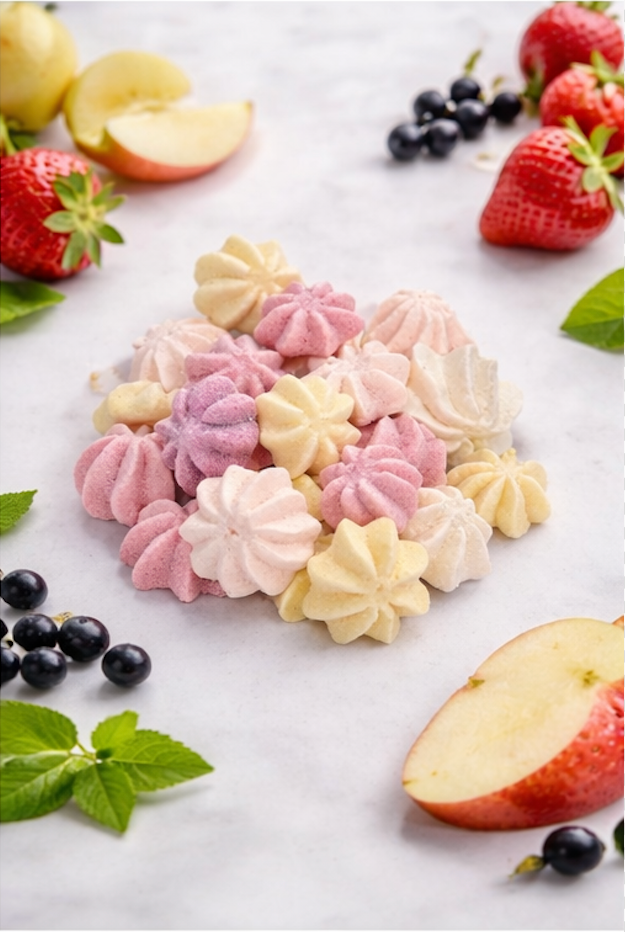
Our Marshmallows are a set of unique marshmallows from Switzerland, created by the K’Apples team and described as having 5 times less sugar than the original. They offer a ready-made example of a marshmallow product to consider alongside the different structures described here.
Sugar syrup shapes chewiness and smoothness
Concentrated sugar syrup adds body and chew to a marshmallow. When the sugar dissolves evenly, the finished texture feels smoother; unwanted crystals can create a gritty or grainy bite.
Corn syrup helps limit crystallization because its different sugars interfere with the formation of large sugar crystals. Keep stray crystals from forming along the pan’s sides during cooking, where they can seed crystallization in the syrup.
The balance of sugar, syrup, water and gelling ingredients affects firmness as well as sweetness. Changing the sugar alone changes the structure too, so a lower-sugar formula needs its foam and setting ingredients to support the texture in another way.
Marshmallow fluff is a soft, spreadable foam rather than a cuttable confection with a stable set. Marshmallow sauce is formulated to stay spoonable or pourable, while meringue is an egg-white foam that is typically baked or otherwise stabilized without the same gelatin network.
Pectin and egg whites create a different kind of set
Pectin is a plant-derived polysaccharide that forms a gel network, while gelatin forms a network of proteins. Their mouthfeel and elasticity differ, so pectin and gelatin are not interchangeable one-for-one.
Pectin’s behavior depends on its type and the recipe. High-methoxyl pectin typically needs enough sugar and acid to gel, while low-methoxyl pectin relies on calcium ions, so a successful set depends on matching the pectin to the formulation.
When egg whites are whipped into an apple-and-pectin mixture, the egg proteins help support aeration while the pectin contributes to the set. Together, they can create a springy marshmallow-style snack without gelatin, although the result is distinct from a conventional gelatin-based marshmallow.
Nuages marshmallows are described as made with cooked apple purée and pectin instead of sugar and gelatin, with no sugar added and no gluten. At CHF 3.50, they illustrate how an apple-and-pectin formulation can offer a different route to a marshmallow-style texture.
Small process changes can make the result firmer or softer
Whipping less air into the mixture generally creates a denser marshmallow. Whip until the foam is stable and even to support a lighter, more uniform texture.
If the syrup is under-concentrated, the set can be softer and less stable. A more concentrated syrup can contribute to a firmer, chewier result, so careful cooking matters as much as the ingredient list.
Let the mixture set undisturbed so its foam and gelling network can stabilize. Cutting or handling it too early can deform the structure before it has fully set.
For a denser, chewier marshmallow, use less aeration or a firmer syrup structure. Simply adding more gelling agent can make the set too firm rather than preserving a soft spring.
Heat softens marshmallows and makes them puff
Warmth softens the structure and makes the sugar phase less firm, so a marshmallow first feels softer. As heating continues, the foam walls weaken and can eventually collapse.
Trapped air expands as it warms, which makes a marshmallow puff up over a flame or in the oven. Continued heat softens the bubble walls, so the puffed confection can slump or melt.
The outside browns through heat-driven reactions, including the Maillard reaction; sugar browning also contributes during toasting. The surface can brown quickly while the middle remains soft.
A marshmallow does not simply melt in your mouth. Warmth softens its structure, saliva dissolves the sugar, and the foam breaks down as you chew.
Moisture changes softness, stickiness and shelf texture
Sugar attracts water, so humid storage can make marshmallows tacky or softer. Keep them sealed in a cool, dry place to limit moisture exchange.
Moisture loss can make marshmallows firmer or drier. A texture change after storage therefore does not necessarily mean the original recipe was denser.
Avoid leaving marshmallows uncovered near damp foods. The surface can absorb moisture, encouraging pieces to stick together and changing the way the outside feels.
Separate recipe effects from storage effects when comparing marshmallows: the ingredient balance and process establish the structure, while later moisture gain or loss changes softness and mouthfeel.
Frequently Asked Questions
How long do homemade marshmallows keep?
Most homemade marshmallows keep for about 2 to 3 weeks at room temperature when stored in an airtight container. Recipes with fresh fruit purée or other perishable additions have a shorter storage life.
Can homemade marshmallows be frozen?
Yes, homemade marshmallows can be frozen in an airtight freezer container for up to about 3 months. Let them come to room temperature while still covered to reduce condensation on the surface.
Are marshmallows gluten-free?
Marshmallows made with sugar, water, gelatin and egg whites contain no gluten grains, so that common formulation is gluten-free. Recipes that use wheat-based starch or other gluten-containing ingredients have a different composition.
Can marshmallows be made without animal-derived ingredients?
Yes, vegan marshmallow recipes can use plant-based gelling ingredients such as agar or pectin, with aquafaba or another plant-based foam component. The balance must be developed for those ingredients because they do not reproduce gelatin’s elastic set in a direct one-for-one swap.
Is homemade marshmallow mixture safe to eat before it sets?
Use pasteurized egg whites in recipes that leave egg whites uncooked or do not reliably heat them through. A hot syrup step does not make every recipe’s egg-white mixture equally safe, since the final temperature and handling determine how much heating occurs.
See also: K Extra New Photo, K'Apples. All the flavours.
Conclusion
Marshmallows: What Creates Their Soft, Springy Texture? A whipped foam supplies lightness, while proteins and gelling ingredients help it hold its air cells; sugar syrup and moisture shape its chew, softness and stability. Whipping, cooking, setting, heating and storage all change how that structure feels.
