
· By www.kapples.ch
Which is better for a child: apple sticks or cooked apple jellies? (2026 guide for safer, calmer snack time)
Which is better for a child: apple sticks or cooked apple jellies? In 2026, we still have to start with the uncomfortable truth, raw apples are among the top 5 foods responsible for fatal choking incidents in children under age 3.
Key Takeaways
| Question parents ask | Best practical answer |
|---|---|
| Which is better for a child: apple sticks or cooked apple jellies? | For the youngest kids, cooked apple jellies are usually the safer texture choice, then progress texture as skills develop. |
| Is “natural” always “safe”? | No. Texture matters. In 2026, we keep it clean label, no shortcuts, and we design for easier chewing and handling. |
| What about gluten and added sugar? | Choose a no gluten no sugar added natural product, and aim for snacks that respect the fruit’s structure. |
| Where does Kapples fit? | Our range includes cooked apple jellies (M’Apples) and kid-on-the-go apple bars (K’Sticks). See all products. |
| Want variety for picky eaters? | Try the K'Apples all the flavours or mixed kits. |
| Are awards part of the decision? | They matter because they validate innovation and clean label consistency. We won innovation prize in Switzerland in 2023 and 2024, and innovation prize 2026 in Europe, plus Gold and Silver for specific flavours in 2026 in Europe. |
If you have ever reached for a “healthy” fruit bar and wondered if it was really built for your child’s chewing skills, you are not alone. Texture, stickiness, and firmness change the whole snack experience, especially in 2026 when parents want clean label and calmer mealtimes.
We try to make the decision simple: keep the fruit’s natural integrity, keep the fiber, and add nothing unnecessary. This is exactly the philosophy behind every single product we make at Kapples: a natural product that respects the fruit, keeps the fiber, and adds nothing unnecessary.
Why the texture question matters most for “Which is better for a child: apple sticks or cooked apple jellies?”
When parents ask “Which is better for a child: apple sticks or cooked apple jellies?”, they usually mean two things at once. First, is it easier to chew? Second, is it less risky if a child’s bite is clumsy.
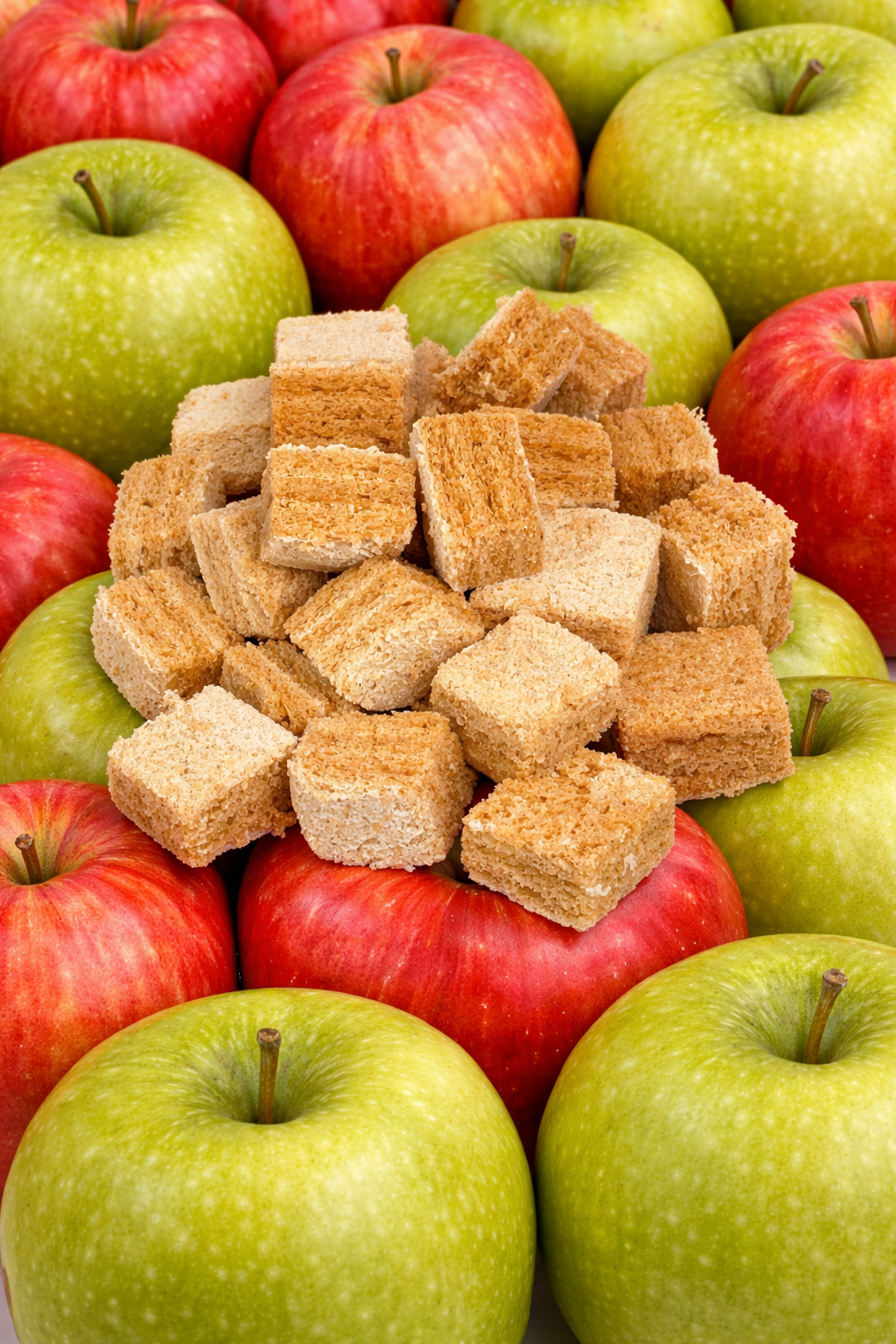
In practical 2026 terms, apple sticks are a “raw-like” texture category. That means higher resistance, more tendency to create stubborn pieces, and more variation in how a child breaks them down.
Cooked apple jellies are a different structure. Soft bites behave more like a spoonable or wobble-able texture. That can make it easier for younger kids to manage in their mouth, especially as you teach chewing and swallowing coordination.
We always come back to one idea, the apple’s natural structure is respected, not destroyed. Then the product form determines how your child handles it, and in the youngest age bands that difference is everything.
Our simple rule for 2026: if your child is still learning texture tolerance, cooked formats usually fit better than stick formats.
Safety first in 2026, what the choking guidance implies for sticks vs jellies
We do not treat “healthy” as a texture substitute. In 2026, parents want data-driven guidance, and safety is the first filter we apply.
Solid Starts has been clear in their recommendations for caregivers. For very young kids, raw apples can be a high-risk choking hazard, and they also describe cooking apples as a good way to go. The overall message is consistent, modify the apple texture for your kiddo as early as you can.
We are not saying every child responds the same way. We are saying the starting point should be safer by default for age-appropriate texture development.
Chewing and swallowing skills, how apple sticks usually progress vs cooked apple jellies
Think of snack texture like a training program. You want the right “difficulty level” on day one, not the maximum difficulty your child could eventually handle.
Apple sticks demand bite pressure, tearing, and chewing until the piece is soft enough. Many kids can learn that skill over time, but in early stages they may not consistently break the piece down into a safe size.
Cooked apple jellies generally reduce that pressure requirement. The structure supports smaller, more manageable bites. That can help you offer a fruit-based snack while you still build chewing confidence.
This is exactly why we include M’Apples as a cooked apple jelly option in our lineup. On the other hand, K’Sticks are built as an on-the-go apple bar for kids on the move. Different use case, different texture job.
No gluten, no sugar added natural product, and why ingredient honesty matters after texture safety
Once safety is handled, ingredients are the next thing parents ask about. In 2026 we still hear the same expectations, clean label, no chemicals, and straightforward fruit character.
We always try to use local ingredients, and we use no chemicals in our 100% natural product. We also keep it no gluten no sugar added natural product. That means you can focus on one thing, the fruit experience, not a long list of add-ons.
For your child, that matters because a snack should support habits you can feel good about. For mothers and fathers planning daily snacks, it should be easy to trust.
For sports, the texture and the clean label positioning also matter. For example, a kid who wants to grab something between activities needs a snack that does not crumble, does not behave like candy, and does not add sugar for the sake of flavor.
If you want a simple starting point across the range, check our assortment pages like K'Sticks healthy apple bars options and M'Apples cooked apple jellies.
How to choose in 2026 by age, not by marketing claims
Here is the honest pattern we see every day in 2026. Parents want one rule that covers everyone. But children develop texture tolerance at different speeds.
So we use a practical approach. For younger eaters, cooked apple jelly formats tend to be the better first step. For older kids who handle bite pressure well, apple sticks can become a fine option, as long as portion size and supervision match your child’s skills.
Feeding Littles has also recommended modifying apples until around age 4 to make them safer for your kiddo. That aligns with the same core truth, in early stages the “form” of the apple matters as much as the apple itself.
Budget and portion planning, what parents actually pay for sticks vs cooked jellies
Texture decisions are easier when you also consider practical logistics, cost and portioning. In 2026, many families want predictable snack portions for school and outings.
From our collection pricing, here are simple reference points. K’Sticks. Healthy apple bars are $5.00, and M’Apples. Cooked apple jellies are $5.00 in the assortment. That means the “stick vs jelly” decision is not a price penalty, it is a texture match choice.
If you want variety without picking one flavour first, our range includes mixed options too, like a K'Apples mix and also multi-flavour packs such as K'Apples all the flavours.
For families who plan weekly gifting or want a full tasting cycle, the K'Apples Maxi Kit is $87.00. For everyday texture training, the cheaper, simpler packs are usually the better starting point.
- $5.00 reference, K’Sticks. Healthy apple bars
- $5.00 reference, M’Apples. Cooked apple jellies (assortment)
- $10.00 reference, K’Apples all the flavours
A cleaner label story you can feel confident about, Swissness Standard in 2026
We do not believe “natural” should be vague. Strip the fiber, add sugar, use concentrate, import from unknown orchards. That is not our direction.
Our clean label guide is practical. We use no chemicals in our 100% natural product. We aim for local ingredients, we respect the fruit, and we design products that keep the fiber.
That is also why our approach is tied to Swissness Standard. We choose depth instead of breadth, Jedes Produkt, das wir herstellen, wird mit dem gleichen ehrlichen Engagement für saubere, natürliche Zutaten gefertigt. Our focus stays tight, and the output stays consistent.
In 2026, innovation still matters because parents want products that solve texture and ingredient problems at the same time. We have won innovation prize in Switzerland in 2023 and 2024. We also won innovation prize 2026 in Europe, plus Gold for K’Apples with apple and cinnamon and Silver for Raspberry and Strawberry tastes in 2026 in Europe.
If you want to explore the range in one place, start with K'Apples all the flavours options and then add an appropriate texture category, K’Sticks for on-the-go and M’Apples for softer cooked jellies.
What we would choose, if we were feeding our own child today
Our recommendation is simple. For the youngest kids, cooked apple jellies are the better starting point for the “Which is better for a child: apple sticks or cooked apple jellies?” question. Not because apples are bad. Because raw-like stick textures can be unforgiving.
Then, as skills grow, you can progress texture. That is how you build confidence without forcing a child into a texture that is too hard too early.
We also like offering a clean label, no gluten no sugar added natural product snack that fits real life. K’Sticks are our on-the-go apple bars, M’Apples are our cooked apple jellies, and K’Apples provide variety. Together they cover most parent needs, from snack for kids to snack for mothers and snack for sports.
And yes, we keep it award winning snack, most innovative snack in Europe 2026 gold medal snack. We are not shy about the work behind it.
Conclusion
Which is better for a child: apple sticks or cooked apple jellies? In 2026, we would choose cooked apple jellies as the safer texture starting point for younger kids, especially when you are still building chewing and swallowing skills. Apple sticks have their place for older children, but they should come after the safer texture stage.
If you want a no gluten no sugar added natural product local apples healthy snack that fits real routines, explore K’Sticks for the on-the-go moment and M’Apples for the softer bite. This is exactly the philosophy behind every single product we make at Kapples, Fibermaxxing in 2026 with clean label ingredients and an honest commitment to safe, natural snacking.
Frequently Asked Questions
Which is better for a child: apple sticks or cooked apple jellies for toddlers?
For toddlers in 2026, the better texture choice in most households is cooked apple jellies because the bite is softer and easier to manage. When you ask which is better for a child: apple sticks or cooked apple jellies, you are really asking for age-appropriate texture safety first.
Are cooked apple jellies safer than apple sticks for kids under 3 in 2026?
Yes, because raw apple textures are commonly flagged as choking hazards for children under age 3, and guidance often supports cooking apples as a safer approach. That is why cooked apple jellies usually beat apple sticks as the “default” option in 2026.
Is it worth buying a no gluten no sugar added natural product apple snack for kids?
If your goal is clean label in 2026, yes. A no gluten no sugar added natural product helps you avoid added sugar while still offering a fruit-based snack for kids that fits school bags and busy days.
Can I give apple sticks or cooked apple jellies to my child at daycare or school?
Yes, but choose based on your child’s current chewing skills and the snack format you can trust. In 2026, many parents pick cooked apple jellies for younger eaters and apple sticks later when the chewing pattern is more consistent.
Do apple-based snacks with chocolate change safety or nutrition for children?
Chocolate additions do not automatically fix texture risk, so the key factor remains the same, the form and softness. Nutrition-wise, if you’re choosing a no gluten no sugar added natural product, you keep the label clean and focus on the fruit and fiber.
What is the best way to transition from cooked apple jellies to apple sticks?
Start with cooked apple jellies, then progress in small steps as your child shows reliable chewing and swallowing. In 2026, the safest mindset is still to modify apple presentation until closer to age 4 when texture handling improves.
