
· By www.kapples.ch
The reseller display stand: maximizing revenue per square centimeter
The reseller display stand: maximizing revenue per square centimeter is a practical retail challenge: use the display’s space well without compromising access, availability or profit. We recommend measuring sales consistently, matching the stand to shopper flow and judging results alongside the work and costs required to keep it stocked.
Key Takeaways
- Measure consistently: Divide sales for a defined period by a clearly defined display area, and keep both definitions the same in every comparison.
- Protect shopper access: Place the stand where relevant shoppers can notice it and pause without blocking aisles or neighboring products.
- Choose a manageable assortment: Give space to items with demonstrated demand while keeping products visible, reachable and easy to replenish.
- Track more than revenue: Monitor on-shelf availability, inventory turnover, contribution margin and operating costs.
- Test for incremental sales: Compare stand sales with the products’ baseline and nearby shelf sales to see whether the display adds demand or shifts purchases.
- Start with a suitable range: Our guide to ordering a reseller display stand without buying a large assortment explores a focused starting point.
Measure the stand’s space productivity consistently
Calculate revenue per square centimeter by dividing sales during a defined period by the display area in square centimeters. Use the same sales definition and time period each time so your comparisons reflect performance rather than changes in the calculation.
Define the area before you start. The fixture’s base footprint measures the space the stand itself occupies, while its full allocated zone also includes the room shoppers need to approach, browse and pick up products.
Neither denominator is universally right for every decision. Use the base footprint when assessing the fixture itself, and the full zone when evaluating how effectively the display uses its broader selling area; do not switch between them in a comparison.
There is no single revenue-per-area figure that makes a stand successful in every store. Compare similar displays, store formats and time periods, rather than judging a small shop, a gym and a larger retail floor against one store-wide average.
Revenue per square centimeter is one view of space productivity, not a verdict on profit. Our guide to the real return behind the K’Apples reseller display stand is relevant when you want to think beyond sales totals and assess the display’s broader commercial role.
Choose a stand and placement that suit the space
Place the stand where the relevant shoppers naturally pass and can pause. A display that interrupts an entrance, narrows an aisle or blocks access to neighboring products can make browsing less comfortable and the products harder to reach.
Match the stand’s role to the shop’s layout and audience. A compact browsing area needs room for people to stop and choose, while a high-traffic route needs clear movement around the fixture; in both cases, leave working room for replenishment rather than filling every spare centimeter.
Compare stand configurations by what they hold and the job they do, not by footprint alone. A ready-to-sell selection may suit a shop looking for a straightforward launch, while a broader assortment may better support a placement where shoppers have time to explore.
The Swiss Stand is a full reseller display for shops, gyms, museums, schools and universities, priced at CHF 412. It includes free delivery and installation, with a 36-hour wholesale lead time, making it a clear option to assess when a retailer wants a complete display setup.
Before placing any stand, watch how shoppers move through the area and whether they can reach the display from more than one approach. A placement that gives people a comfortable pause can support browsing without using aisle space as extra display space.
Build an assortment around shopper demand and stand capacity
Give display space to products with demonstrated demand among your shoppers. Use sales by item and on-shelf availability to guide the product assortment, because sales alone may not show the full picture of shopper demand.
Balance variety with visibility. Too many items can crowd a stand, hide product choices and make replenishment slower; a range that is too narrow can overlook distinct shopper preferences.
Keep each format easy to identify and reach, and leave working room to replenish it. A practical planogram gives products a deliberate position while preserving the open space needed for shoppers to pick up items and staff to restock.
The K’Apples display stand for resellers is a ready-to-sell mix with 6 x 65 g Pomme à la cannelle, 15 K’Sticks with a basket and one 135 g tasting jar, for $411. Free delivery and installation are included, so this format offers a specific assortment retailers can assess against their stand capacity and replenishment routine.
The Display stand for resellers package is organized around curated best sellers, assorted snack formats and a tasting jar, ready for local placement; its listed price is 411. Compare it with a focused snack-and-tasting mix by considering the range, format visibility and restocking each one requires.
Retailers comparing flavors and formats can also browse the linked options below. The links provide routes to different K’Apples, K’Sticks and related product selections for assortment planning.
Explore linked flavor and format selections
- K’Apples flavor selections: K’Apples flavor option 1 · option 2 · option 3 · option 4 · option 5 · option 6 · option 7 · option 8 · option 9 · option 10 · option 11 · option 12 · option 13 · option 14 · option 15 · option 16 · option 17 · option 18 · option 19 · option 20 · option 21 · option 22 · option 23 · option 24 · option 25 · option 26 · option 27 · option 28 · option 29 · option 30.
- Fruit mix selections: mix option 1 · mix option 2 · mix option 3.
- Maxi kit selections: kit option 1 · kit option 2 · kit option 3 · kit option 4 · kit option 5 · kit option 6.
- K’Extra: K’Extra product selection and K’Extra visual reference.
- K’Sticks selections: bar option 1 · option 2 · option 3 · option 4 · option 5 · option 6 · option 7 · option 8 · option 9 · option 10 · option 11 · option 12 · option 13 · option 14 · option 15 · option 16 · option 17 · option 18 · option 19 · option 20 · option 21 · option 22 · option 23 · option 24.
- Mapples: Mapples selection · option 1 · option 2 · option 3 · option 4.
- Nuages: selection 1 · selection 2 · selection 3 · selection 4 · selection 5 · selection 6.
- Mystery selection: K’Apples option.
Use clear merchandising and complementary products
Keep the most relevant products visible at a glance, and group related formats so shoppers can understand the range quickly. Clear grouping supports cross-merchandising without making people search through a dense display.
Complementary formats can encourage a larger basket when the connection is easy to understand. Keep space between products so shoppers can pick up one item without disturbing the rest of the stand.
Sampling can help introduce unfamiliar flavors when the store can support it. Track purchases during tasting periods and compare the result with the staff time and display space used.
For a stand with Sweet and Sour variants, the Display stand for resellers is priced at 403 and is filled with the brand’s best sellers. Its listed variants provide a distinct merchandising mix to assess for visibility and shopper interest.
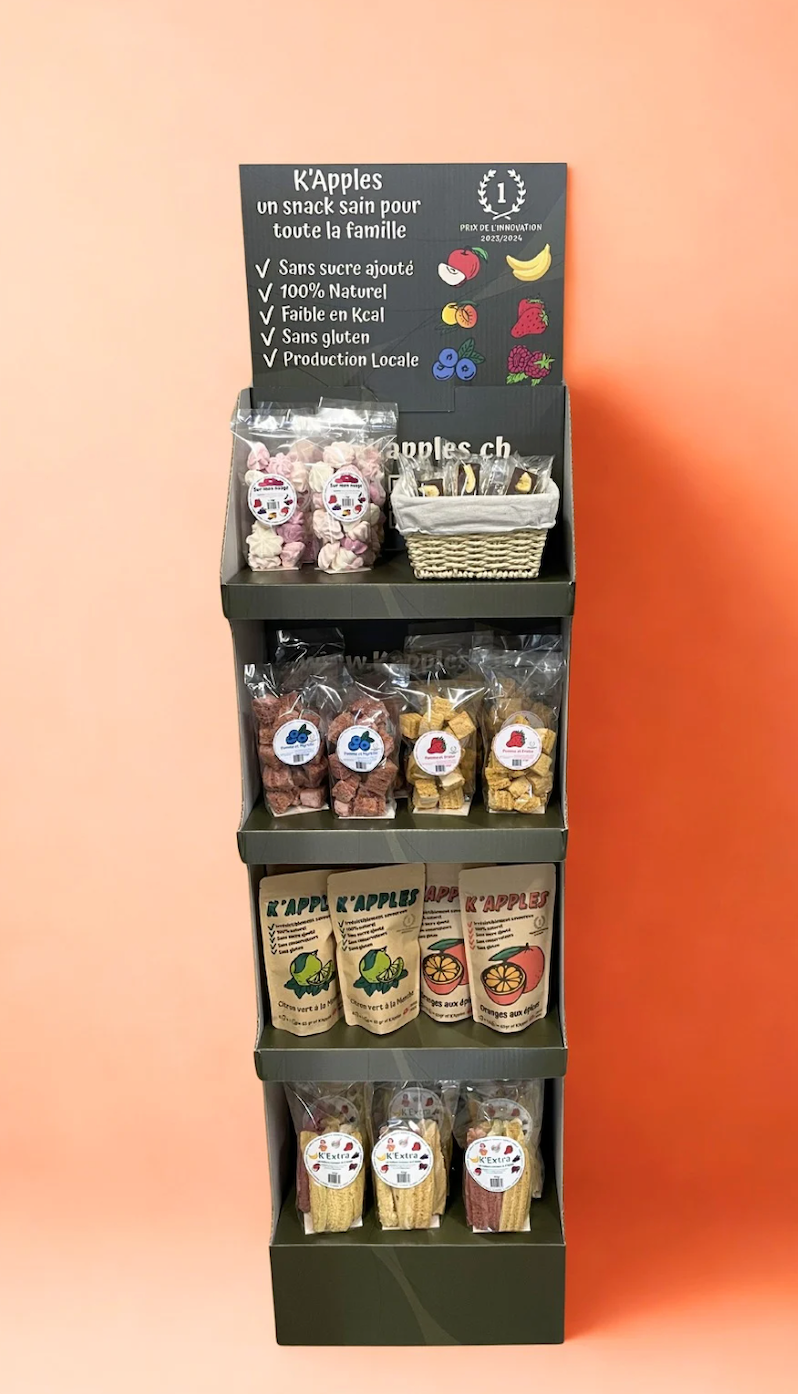
A wider range of pack sizes and bars is the focus of this Display stand for resellers, priced at $411. It is pre-filled with best sellers, including seven 65gr flavors, 9 × 100gr K’Extra, 15 pieces K’Sticks and a tasting jar, with free delivery and installation.
We make our products 100% natural, without gluten or sugar added, and use no chemicals. We try to use local ingredients, which gives retailers clear product attributes to communicate alongside flavor and format.
Track stock, turnover and stand-level costs
Track sales and on-shelf availability by product. Record stock gaps alongside point-of-sale results, since sales alone may not show whether shoppers wanted an item.
Monitor inventory turnover with sales density. A high-selling stand can still create avoidable work if it needs constant replenishment, and popular items can lose sales when staff cannot keep them available.
Assess contribution margin, not revenue alone. Subtract product costs and relevant fixture, replenishment and labor costs to understand whether the reseller display stand contributes profit after the work required to run it.
A ready-to-go mix with varied pack sizes, bars and a tasting jar can support broader browsing, but it also calls for space and staff time to maintain. The Display stand for resellers is listed at $411 and includes 6 × 65g assorted-flavor packs, 9 × 100g K’Extra, 15 K’Sticks and one 135g tasting jar, with free delivery and installation.
Revenue per square centimeter can reveal where sales are concentrated, while contribution margin shows what remains after costs. Review the two together before giving more room to a high-revenue product or display.
Food and beverage manufacturers commit a major portion of total revenue to trade promotion practices.
Source: International Journal of Environmental Research and Public Health
Test whether the stand adds sales
Before introducing the stand, establish a baseline for the products it will carry. After placement, compare the products’ sales from the stand with their sales on nearby shelves, so you can see whether shopping behavior changed across the whole zone.
Where possible, compare the result with a similar period or location without the display. Account for promotions, seasonality, store format and stockouts, as each can affect the comparison independently of the stand.
Check whether nearby products lost sales at the same time, then assess the combined change in the stand and surrounding zone rather than relying on a store-wide average.
Our guide to display return in European boutiques discusses ways to follow daily sales, product placement and repeat purchase patterns while refining a display.
Adjust the display using comparable results
Review sales by stand, product and time period alongside shopper traffic, availability and contribution margin. This combination helps distinguish low demand from poor visibility, stock gaps or excessive operating costs.
Change one major factor at a time, such as placement, product allocation or display arrangement. When you change several things together, the next measurement cannot clearly show which adjustment influenced the result.
When comparing stores, keep the area definition consistent and account for differences in retail format, promotions and seasonal demand. A stand that performs well in one setting may need a different assortment or position in another.
Move space away from a persistently weak zone only after checking visibility, availability and replenishment. Once those operational issues are addressed, sales and margin results can guide a more reliable allocation of display space.
Frequently Asked Questions
Should revenue per square centimeter be calculated using gross sales or net sales?
Use gross sales when the question is how much shoppers rang through at the stand, and net sales when you want the amount retained after discounts and returns. Choose the measure that matches the decision, then apply it consistently to every display in the comparison.
How often should a retailer review a display stand’s assortment?
Review it when you place a reorder and after a meaningful change in promotions, season or shopper mix. That timing connects the assortment decision to actual sales and replenishment rather than prompting changes simply because the display looks familiar.
Can a reseller display stand perform well away from the checkout?
Yes. A stand can suit a relevant category area, a waiting space or another route where its intended shoppers naturally pass, provided the placement gives them a clear reason to stop and browse.
How should discounts and returns be treated when comparing stand performance?
Record discounts against the period in which they were offered, and subtract returns consistently from the sales measure you selected. Keep promotional periods identifiable in your records so you can separate the display’s underlying performance from a temporary price change.
Should a tasting jar stay on the display all the time?
Use the tasting jar during selected periods, then compare them with non-tasting periods to assess whether its space and staff attention serve the stand’s purpose.
Conclusion
The reseller display stand: maximizing revenue per square centimeter starts with a consistent area definition, a shopper-friendly location and an assortment that fits both demand and replenishment capacity. Track availability, turnover and contribution margin alongside sales, then test whether the stand adds purchases across its surrounding zone before changing its space allocation.
